


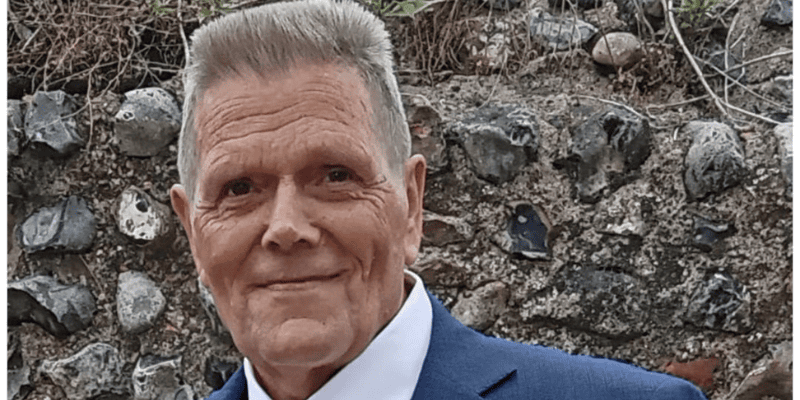
How did St Clare Hospice become involved in your lives?
It all started when my husband, Alan got diagnosed with a brain tumour in 2025. Over those next couple of months, things started to change – his understanding, his movement…. everything just slowly deteriorated. It wasn’t something we noticed straight away because when anything happens slowly, you don’t always see it.
About six weeks ago, we went to see Dr Adam Mitchell in oncology. We told him we’d noticed a change, and he had noticed the change too. From there, he said, “I’m going to do the referral to the hospice.” He explained that it was far better to have support in place just in case.
At the time, it felt like we were living in reality but didn’t want to know reality if that makes sense. It was like being a detached from it. But I thought it was a good idea because I always believe it’s better to plan ahead rather than panic in a crisis. The support we’ve had from the hospice team – the nurses and consultants – has been amazing. I trust them, and I’ve got faith in them.
How did Alan’s brain tumour present itself?
It started around April or May last year. Alan began saying his coordination was off when he was walking. He said he had to think about how he was walking. Then he started having these fear attacks. He said, “It sounds stupid, but it feels like a tiger is going to attack me. There’s no tiger, but that’s the fear I’ve got.” He couldn’t explain it.
He had always had a great memory for things he was interested in, like history or football – he could even remember dates players were signed…. but he was now forgetting things which wasn’t like Alan. So that was a worry too.
I took him to the doctor, and she tested him. She said she’d refer him to the memory clinic, but I knew he needed an MRI, and so she was good and agreed to get one urgently. That scan showed the tumour, and it was after that when everything started moving quickly.
What happened after Alan’s diagnosis?
It was a massive shock. We went to see the consultant, and he was very clear with us. He said, “We can offer you quality of life, or we can offer you longer life.” He explained that the tumour was terminal, but they could extend Alan’s life with treatment, though it wouldn’t improve his quality of life.
Alan decided he wanted to live. He wanted to have the biopsy and the treatment. That was his decision, and I respected it. Even with the radiotherapy and everything else, he still had this fight in him. He kept saying, “I want to live.”
What was Alan like before he became unwell?
Alan was always busy. He loved working on the house, the garden, the windows, the loft – you name it, he’d be up a ladder doing it. He was constantly decorating or fixing something. He’d do anything for anyone.
What happened when Alan was admitted to hospital?
Alan had a fall, and he was admitted to hospital. He was so stressed in hospital. He got so distressed that he said, “That’s it. I’m waiting to die now.”
I knew that Alan just needed to be at home and I did everything I could to get him home. My kids say I’m bossy, and I was, and it paid off. I was so determined.
What was it like bringing Alan home?
It was seamless. The hospice team were amazing. They communicated everything so well, and they stayed involved until the NHS care plan was in place. At first, I couldn’t imagine carers coming into my home. We’ve always been independent, and I thought, “I can do this. I can cope.” But when they came in, it was such a relief.
They were so lovely, and Alan responded to them. He even gave them compliments! He’s always been very grateful and well-mannered. He appreciated what they did for him, and it gave me some support too.
The carers gave us routine. They come in the morning to wash him, then at lunchtime and in the evening. It’s given us structure, and it’s been a huge help.
What has the hospice’s support meant to you?
I don’t know where we’d be without St Clare Hospice. It doesn’t bear thinking about. The communication has been second to none. I can call the helpline anytime, and they’ll help me. They even contact the surgery or district nurses on my behalf.
The hospice has given Alan dignity, which is so important to him. They’ve treated him with respect and compassion, and that makes all the difference. The hospital staff try their best, but they just don’t have the time or resources to provide that level of care.
Why did you decide to give Easter eggs to the hospice staff?

Alan has always been appreciative and generous. He’s the type of person who would always say, “Buy them chocolates or get them a card.” That’s just how he is, and that’s how we are as a family. So we decided to give Easter eggs to the hospice staff as a thank you.
What’s next for you and Alan?
Alan is at home now, and that’s where he wants to be. The hospice team have been amazing, and I know I can call them if I need anything. Some days are harder than others, but I try to find a balance. I think it’s important to sit with the sadness and pain sometimes, but also to give yourself permission to move forward. The hospice has made such a difference to our lives. They’ve been genuine, compassionate, and kind, and I’ll always be grateful for that.
– Maureen, Alan’s wife
Alan died at home on Saturday 28 March, with Maureen holding his hand. Thank you to Maureen and the family for sharing their story with us to help show the impact St Clare Hospice has on local families.